ship logo General Reference Guides Census Records Military Records African-American Records Other States New Titles E-Books
          Home             Reference                 Census Records       Military           African-American         Other States         New Titles           E-BOOKS     FREE SHIPPING IN USA

Iberian Publishing Company's On-Line Catalog:
Pittsylvania County Virginia


Map of Va: Pittsylvania CountyPittsylvania County was established in 1767 from the western lands of Halifax County. The new county, the largest in Virginia at the present time, was named for William Pitt, first earl of Chatham, a famous British statesman who championed the Americans' claims prior to the Revolutionary War. In 1776 Henry County was formed from Pittsylvania. The county has remained stable since then.

For a better understanding of county boundary changes, see our new section Virginia in Maps
Iberian also has hundreds of titles in e book (PDF) format!! Click here for a complete online catalog of available titles


PITTSYLVANIA COUNTY, VA 1810 SUBSTITUTE CENSUS [Abstracts from the 1810 Personal Property Tax List] by John Vogt, 2011, 8 1/2"x11" format, vi, 18 pages, map.
        Pittsylvania is one of eighteen Virginia counties for which the 1810 census is lost. In August, 1814 British troops occupied Washington, DC and public buildings were put to the torch. In the destruction that followed, numerous early records of the government were lost, including all of Virginia's 1790 and 1800 census reports, as well as eighteen county lists for the state's most recent [1810] federal census. Although two "fair copies" of each county's census had been left in the counties for public display, these were ephemeral lists and not preserved, and by 1814 they too had been mislaid, lost, or destroyed. Hence, the closest document available we have to reconstruct a partial image of the missing county lists is the personal property tax list.
       According to research notes by Minor T. Weisiger, Library of Virginia archivist: Information recorded in Virginia personal property tax records changed gradually from 1782 to 1865. The early laws required the tax commissioner in each district to record in "a fair alphabetical list" the names of the person chargeable with the tax, the names of white male tithables over the age of twenty-one, the number of white male tithables between ages sixteen and twenty-one, the number of slaves both above and below age sixteen, various types of animals such as horses and cattle, carriage wheels, ordinary licenses, and even billiard tables. Free Negroes are listed by name and often denoted in the list as "free" or "FN."
Surname list

       The present abstract of Pittsylvania's 1810 personal property tax list is NOT a transcript of the entire document; rather, it is a summary of three items important in delineating the 1810 "substitute" census for this county, i.e., number of male tithables 16 and older, number of slaves twelve years and older, and the number of horses. The original form of the census was in alphabetic order by date and letter. The substitute list presented here is in absolute alphabetic order for easy reference.

In the current volume, the data is recorded thus:
        Going, John (free negro)
                (Sycamore)                    1    -    1
        Goodman, Edmund                1    -    1
        Goodwin, John H. & son
                Robert (Smith's Mt.)    3    1    8

        Column one represents the tithable males (16 and over) in the household; column 2 is the number of slaves over 12; and the final column is the number of horses, mares or mules.
        For genealogical researchers in this 1810 period, personal property tax records may provide additional important information. Oftentimes, juniors and seniors are listed adjacent to one another and recorded on the same day. When a taxpayer is noted as "exempt", it can be a clue to someone holding a particular position in government or being elderly, infirm, or for some other reason no longer required to pay the tithable tax. Women, both black and white, appear occasionally as heads of households when they own property in their own right or as the widow of a property owner.
        Another valuable source for filling in information about an ancestor is the land tax record, and especially the one for 1815. In that year, the enumerators began to add the location of the property in relation to the county court house. Roger Ward has abstracted all of the 1815 land tax records, and they are available from this publisher at www.iberian.com.
        The 1810 substitute census list for Pittsylvania County contains 2,026 households, 2,753 tithables, both white and free black, and 3,477 slaves over the age of twelve, and 5,572 horses.

Add to Cart

[PTPP] $7.50     (printed version)


The above title is also available as a digital e-book in PDF format:
Add to Cart

[EPTPP] $5.00     (electronic version)


ENTRY RECORD BOOK [1], 1737-1770 (Land entries in the present Virginia counties of Halifax, Pittsylvania, Henry, Franklin, & Patrick) transcribed by Marian Dodson Chiarito. 1984. 432 pages, 8" x 11. This book contains land entries in the western portion of the original Brunswick County. The area concerned was south of Blackwater Creek and Roanoke-Stanton River, west of Aaron's Creek (which divides Mecklenburg and Halifax counties), and extended to the Blue Ridge Mountains. The North Carolina line was the southern boundary. A complete index of all names, watercourses, mountains, etc.
To view a digital copy of the index to this book, visit Index-Erb1
(Close the pdf file with the left arrow to return to Iberian's catalog)

Add to Cart

[Erb1] $47.95


The above title is also available as a digital e-book in PDF format:
Add to Cart

[EERB1] $30.00     (electronic version)


ENTRY RECORD BOOK [2], 1770-1796 (Land entries in the present Virginia counties of Pittsylvania, Henry, Franklin, & Patrick) transcribed by Marian Dodson Chiarito. 1988. 138 pages, 8" x 11. This book is a sequel to Entry Record Book [1], 1737-1770, published in 1984. The watercourses listed in the index indicate that the area for this volume was Pittsylvania County as it existed in 1770. Pittsylvania was formed from Halifax County in 1767. The map included with the book gives names of most of the early watercourses, and makes possible the location of land entries, adjoining landowners, and other points of interest. A complete index of all names, watercourses, mountains, etc. is provided.
To view a digital copy of the index to this book, visit Index-Erb2
(Close the pdf file with the left arrow to return to Iberian's catalog)
Add to Cart

[Erb2] $27.00


The above title is also available as a digital e-book in PDF format:
Add to Cart

[EERB2] $20.00     (electronic version)


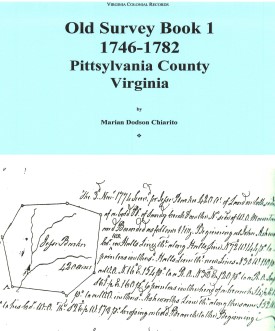
OLD SURVEY BOOK 1, 1746-1782, PITTSYLVANIA COUNTY, VIRGINIA transcribed by Marian Dodson Chiarito. 1988. 400 pages, 8" x 11.

PLEASE NOTE: This book contains surveys of land in Pittsylvania County as it existed in 1767 when it was created from Halifax County. Until 1776, when Henry County was formed, the counties of Henry, Franklin, and Patrick are also included.

It consists primarily of a photocopy of the original surveys found in Old Survey Book 1. The map included with the book gives names of most of the early watercourses, and makes possible the location of land surveys, adjoining landowners, etc. A complete index of all names, watercourses, roads, etc. is provided.
To view a digital copy of the index to this book, visit Index-Pts1
(Close the pdf file with the left arrow to return to Iberian's catalog)
Add to Cart

[Pts1] $37.00


The above title is also available as a digital e-book in PDF format:
Add to Cart

[EPts1] $25.00

[EPts1] $25.00


OLD SURVEY BOOK 2, 1797-1829, PITTSYLVANIA COUNTY, VIRGINIA transcribed by Marian Dodson Chiarito. 1988. 102 pages, 8" x 11. This book contains surveys of land within the present bounds of Pittsylvania County. Although this is a sequel to Old Survey Book 1, which contained surveys made up to 1782, the first survey included in Book 2 was made in 1797. Therefore, survey records for about fifteen years are not accounted for. In Entry Record Book 2, 1770-1796 (See HALIFAX COUNTY), there are marginal notations that indicate some surveys were made during this fifteen-year interval. Old survey Book 2 follows the same format as its predecessor, containing photocopies of the original surveys. The map included is the same as that included in Book 1. A complete index of all names, watercourses, roads, etc. is provided.
To view a digital copy of the index to this book, visit Index-Pts2
(Close the pdf file with the left arrow to return to Iberian's catalog)
Add to Cart

[Pts2] $20.00


The above title is also available as a digital e-book in PDF format:
Add to Cart

[EPts2] $15.00


Pittsylvania Co. 1815 Directory of Landowners by Roger G. Ward. 2005. 49 pages, map, 5 1/2X8 1/2.
For a full description of the 1815 LAND DIRECTORY Records and a listing of available counties, see combined volume below
Add to Cart

[Vd81] $10.00


The above title is also available as a digital e-book in PDF format:
Add to Cart

[EVd81] $7.00     (electronic version)


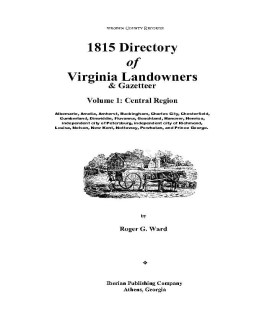
1815 DIRECTORY OF VIRGINIA LANDOWNERS & GAZETTEER, vol. 2 South Central Region (Includes the counties of Bedford, Brunswick, Campbell, Charlotte, Franklin, Greensville, Halifax, Henry, Lunenburg, Mecklenburg, Patrick, Pittsylvania, Prince Edward, Southampton, and Sussex) abstracted by Roger G. Ward. 1997, vi, 234 pages, indices, maps.
In 1782 the General Assembly of Virginia enacted new tax laws which created within each county an enumeration of land and certain personal property. These early land tax laws required a tax commissioner in each district of a county to record a list of the names of persons owning land or town lots, the quantity of land owned and its value, and the amount of tax owed. By 1813, a brief geographic description (usually citing an adjacent stream, road, or other landmark) was required; in 1814, the distance and direction from the courthouse for each parcel was also added to the tax rolls.
The present work is an alphabetical listing of all 1815 landowners found in each county, as well as the accompanying description of the location of the said property. We have not included the number of acres, taxes assessed, or any transactions between landowners which may have been noted on the tax rolls; also, in many cases the geographic location was provided as "adjacent to John Smith", etc. and, while useful many times to a genealogist, was considered to be beyond the objectives of this project. The reader is encouraged to consider the information here-in as an "outline" of early landowners in Virginia rather than a "text" due to the year-to-year variation in information provided to the clerk (or recorded by the clerk), omissions, lack of "identifiers" to determine if "same name" was also "same person" within a district or across districts, marginal quality/clarity (in a few cases) of the microfilm copy, and, not least, errors on the part of either the original clerks or the current author while transcribing.
Some of the approaches to utilizing the 1815 landowner information include:
  1. observe distinct clusters of the same surname within a county in order to clarify the common surnames such as "Smith", "Anderson", etc;
  2. identify non-resident landowners and their county (or state) of residence (these people often being former residents of the current county);
  3. determine neighbors with different surnames (often being relatives);
  4. use the 1815 information as a "bridge" from the 18th and 19th century deed/will books to the 17th and 18th century land grants/patents in the county;
  5. evaluate the 1810 to 1840 census information which generally grouped neighbors;
  6. substitute this information for missing deed/will books in the "burned" counties; and, clarify/enhance vague deed/will information in the counties with more complete records.
FORMAT OF PRESENTATION: Each entry is listed as: Surname, name, personal identifiers (if any); location/place-name of land; miles/direction from the 1815 courthouse. If multiple owners are listed for a property, the listing is duplicated under each of the owner's surnames (i.e "Smith and Brown" is also listed as "Brown, --see Smith"); when multiple owners share a common surname, the property is only listed once. When a landowner had land at more than one location/place-name, the miles/direction listing for each parcel is in the same sequence as the location listing (i.e. James RV, Slate CK; 12N, 5SW.). In the few cases where a landowner had "many" parcels, the miles/direction notation is attached to the location listing (i.e. Sandy RV- 5NE, Willow CK-7S, etc.)

Add to Cart

[Vdl2] $32.00    (paper version)


The above title is also available as a digital e-book in PDF format:
Add to Cart

[EVDL-2] $20.00     (electronic version)


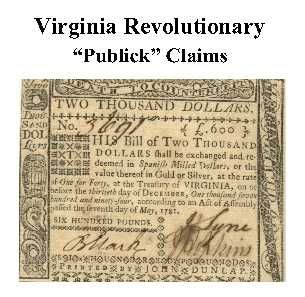
Pittsylvania Co. Revolutionary Public Claims transcribed by Janice L. Abercrombie and Richard Slatten.. 2005. 43 pages, 5 1/2X8 1/2.
For a full description of the Virginia Revolutionary Public Claims and a listing of available counties, see:
Revolutionary "Publick" Claims series


To view a digital copy (pdf) of the index to this book, visit Index-Pittsylvania
(Close the pdf file with the left arrow to return to Iberian's catalog)
Add to Cart

[Pc53] $7.25     (printed version)


The above title is also available as a digital e-book in PDF format:

Add to Cart

[EPc53] $5.00     (electronic version)


For more records pertaining to PITTSYLVANIA COUNTY, VIRGINIA see also:

Please see our HELP PAGE for mail-order instructions, wholesaler policies and other contact information.


|| Virginia/W.Va. || General Reference || Military Records ||
|| Other States || E-Books || New Titles
|| Home Page || E-Books ||

Copyright 2026 Iberian Publishing Company