 1815 DIRECTORY OF VIRGINIA LANDOWNERS & GAZETTEER, vol. 1 Central Region
(Includes the counties of Albemarle, Amelia, Amherst, Buckingham, Charles City, Chesterfield, Cumberland,
Dinwiddie, Fluvanna, Goochland, Hanover, Henrico, independent city of Petersburg,
independent city of Richmond, Louisa, Nelson, New Kent, Nottoway, Powhatan, and
Prince George.) abstracted by Roger G. Ward. 1997, vi, 239 pages, indices, maps.
In 1782 the General Assembly of Virginia enacted new tax laws which
created within each county an enumeration of land and certain personal property. These
early land tax laws required a tax commissioner in each district of a county to record a
list of the names of persons owning land or town lots, the quantity of land owned and its
value, and the amount of tax owed. By 1813, a brief geographic description (usually
citing an adjacent stream, road, or other landmark) was required; in 1814, the distance
and direction from the courthouse for each parcel was also added to the tax rolls.
The present work is an alphabetical listing of all 1815 landowners found in
each county, as well as the accompanying description of the location of the said property.
We have not included the number of acres, taxes assessed, or any transactions between
landowners which may have been noted on the tax rolls; also, in many cases the
geographic location was provided as "adjacent to John Smith", etc. and, while useful many
times to a genealogist, was considered to be beyond the objectives of this project. The
reader is encouraged to consider the information here-in as an "outline" of early
landowners in Virginia rather than a "text" due to the year-to-year variation in
information provided to the clerk (or recorded by the clerk), omissions, lack of
"identifiers" to determine if "same name" was also "same person" within a district or
across districts, marginal quality/clarity (in a few cases) of the microfilm copy, and, not
least, errors on the part of either the original clerks or the current author while
transcribing.
Some of the approaches to utilizing the 1815 landowner information include:
-
observe distinct clusters of the same surname within a county in order to clarify
the common surnames such as "Smith", "Anderson", etc;
- identify non-resident landowners and their county (or state) of residence (these
people often being former residents of the current county);
- determine neighbors with different surnames (often being relatives);
- use the 1815 information as a "bridge" from the 18th and 19th century deed/will
books to the 17th and 18th century land grants/patents in the county;
- evaluate the 1810 to 1840 census information which generally grouped
neighbors;
- substitute this information for missing deed/will books in the "burned" counties;
and, clarify/enhance vague deed/will information in the counties with more complete
records.
FORMAT OF PRESENTATION: Each entry is listed as: Surname,
name,
personal identifiers (if any); location/place-name of land; miles/direction from the 1815
courthouse. If multiple owners are listed for a property, the listing is duplicated under
each of the owner's surnames (i.e "Smith and Brown" is also listed as "Brown, --see
Smith"); when multiple owners share a common surname, the property is only listed
once. When a landowner had land at more than one location/place-name, the
miles/direction listing for each parcel is in the same sequence as the location listing (i.e.
James RV, Slate CK; 12N, 5SW.). In the few cases where a landowner had "many"
parcels, the miles/direction notation is attached to the location listing (i.e. Sandy RV-
5NE, Willow CK-7S, etc.)
[Vdl1] $32.00 (paper version)
The above title is also available as a digital e-book in PDF format:
[EVDL-1] $20.00 (electronic version)
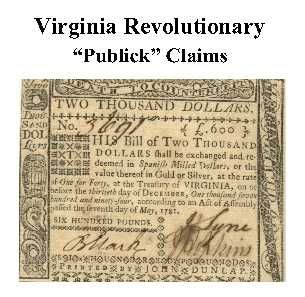 Amherst Co. Revolutionary Public Claims
transcribed by Janice L. Abercrombie and Richard Slatten.. 2005. 50 pages, 5 1/2X8 1/2.
For a full description of the Virginia Revolutionary Public Claims and a listing of available counties, see:
Revolutionary "Publick" Claims series
To view a digital copy (pdf) of the index to this book, visit Index-Amherst
(Close the pdf file with the left arrow to return to Iberian's catalog)
[Pc04] $7.75 (printed version)
The above title is also available as a digital e-book in PDF format:
[EPc04] $4.65 (electronic version)
For other records pertaining to Amherst COUNTY, VIRGINIA see:


Please see our HELP PAGE for mail-order instructions, wholesaler policies and other contact information.
|| Virginia/W.Va. || General Reference || Military Records ||
|| Other States || E-Books || New Titles || Home Page || E-Books ||
Copyright © 2026 Iberian Publishing Company








 Amherst County was formed on 1 May 1761 from territory then part of Albemarle County. It was so named for Major General Jeffrey Amherst, who had commanded the British forces in the colony during the latter part of the French and Indian War, and governor of Virginia from 1759 to 1768. The new county then included territory in the present counties of both Amherst and Nelson. Augusta County formed its western and northern boundary until Rockbridge replaced it in 1778; on the east Amherst was bounded by Albemarle County. In 1769, the Virginia General Assembly settled a dispute between Albemarle and Amherst by dividing the jurisdiction of certain islands in the James River between these two counties. To the south, Amherst was separated from Buckingham and Bedford (after 1782, Campbell) by the James River.
Nelson County was separated from Amherst in 1808 from the northern part of Amherst. At that time Amherst reached its current configuration.
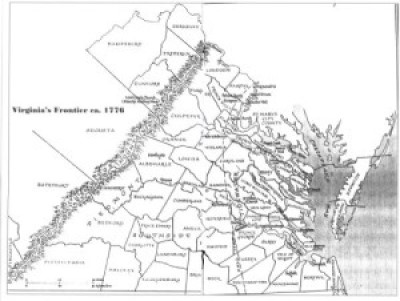 WOLF HUNTERS ON THE VIRGINIA FRONTIER, 1776-1818 [bounty lists & certificates from Amherst, Augusta, Bath, Botetourt, Grayson, Greenbrier, Hampshire, Hardy, Mopntgomery, Patrick, Pendleton, Rockbridge, Russell, Shenandoah, Washington, and Wythe counties [dates vary] transcribed & edited by Karen Wagner Treacy. 8 1/2 x 11, vi, 169 pages, full name index.
 AMHERST CO., VA 1810 CENSUS transcribed by John Vogt. 10 1/2 x 8 1/2, x, 29 pages, illustrations, map, full name index. This is the first surviving
census for Amherst, since both the 1790 and 1800 censuses have been lost. The transcription is in the order in which the enumerator took his census. Thus, neighbors appear together and this will assist the
genealogist. Amherst was an important and populous county at the western edge of Virginia's Piedmont with a heavy slave population [5,600+].