Iberian Publishing Company's On-Line Catalog: Alexandria County Virginia
Arlington County's name comes from Arlington National Cemetery, whose own name had derived from that of Confederate General Robert E. Lee's former home, Arlington House. The area was retroceded to Virginia on July 9, 1846. In 1852, the independent City of Alexandria was incorporated from a portion of Alexandria County. This created an ambiguity, as two separate legal entities had similar names. Alexandria County eventually renamed itself in 1920 to Arlington County.
In December 1789 the Virginia General Assembly offered to cede land along the Potomac River to the federal government so that a permanent seat of government could be established. This was an attempt to place Virginia near the center of the new federal establishment and avoid the capital being located in a more remote northern part of the country. In 1791 the District of Columbia was surveyed and set aside, and ten years later, in 1801, federal offices were moved to the new capital in the District and the federal government assumed jurisdiction.
The land ceded by the General Assembly from Fairfax County to create part of the new district of Columbia was designated as Alexandria County in the District of Columbia.Alexandria County was retroceded to Virginia in 1846 and the Commonwealth extended its jurisdiction over this territory in 1847. The functions of the Levy and Orphans' courts was reassumed by the newly-formed County court. Also in 1847 the Alexandria Circuit Superior Court of Law and Chancery was formed and the functions of the District of Columbia's Circuit and Criminal courts were passed to it. Five years later, in 1852, this Circuit Superior Court of Law and Chancery was superseded by the Alexandria Circuit Court. Finally, as in all Virginia counties, the County Court was abolished in 1904 and its jurisdiction passed to the Circuit Court. In 1920 the name of Alexandria County was changed to Arlington County. See also Alexandria City.
For a better understanding of county boundary changes, see our new section Virginia in Maps Iberian also has hundreds of titles in e book (PDF) format!! Click here for a complete online catalog of available titlescite>Alexandria Co. 1815 Directory of Landowners
by Roger G. Ward. 2005. 6 pages, map, 5 1/2X8 1/2.
For a full description of the 1815 LAND DIRECTORY Records and a listing of available counties, see combined volume below
[Vd03] $5.00 (printed version)








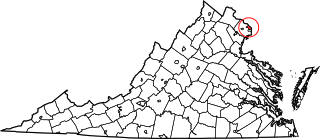 Arlington County's name comes from Arlington National Cemetery, whose own name had derived from that of Confederate General Robert E. Lee's former home, Arlington House. The area was retroceded to Virginia on July 9, 1846. In 1852, the independent City of Alexandria was incorporated from a portion of Alexandria County. This created an ambiguity, as two separate legal entities had similar names. Alexandria County eventually renamed itself in 1920 to Arlington County.
In December 1789 the Virginia General Assembly offered to cede land along the Potomac River to the federal government so that a permanent seat of government could be established. This was an attempt to place Virginia near the center of the new federal establishment and avoid the capital being located in a more remote northern part of the country. In 1791 the District of Columbia was surveyed and set aside, and ten years later, in 1801, federal offices were moved to the new capital in the District and the federal government assumed jurisdiction.
The land ceded by the General Assembly from Fairfax County to create part of the new district of Columbia was designated as Alexandria County in the District of Columbia.Alexandria County was retroceded to Virginia in 1846 and the Commonwealth extended its jurisdiction over this territory in 1847. The functions of the Levy and Orphans' courts was reassumed by the newly-formed County court. Also in 1847 the Alexandria Circuit Superior Court of Law and Chancery was formed and the functions of the District of Columbia's Circuit and Criminal courts were passed to it. Five years later, in 1852, this Circuit Superior Court of Law and Chancery was superseded by the Alexandria Circuit Court. Finally, as in all Virginia counties, the County Court was abolished in 1904 and its jurisdiction passed to the Circuit Court. In 1920 the name of Alexandria County was changed to Arlington County. See also Alexandria City.
Arlington County's name comes from Arlington National Cemetery, whose own name had derived from that of Confederate General Robert E. Lee's former home, Arlington House. The area was retroceded to Virginia on July 9, 1846. In 1852, the independent City of Alexandria was incorporated from a portion of Alexandria County. This created an ambiguity, as two separate legal entities had similar names. Alexandria County eventually renamed itself in 1920 to Arlington County.
In December 1789 the Virginia General Assembly offered to cede land along the Potomac River to the federal government so that a permanent seat of government could be established. This was an attempt to place Virginia near the center of the new federal establishment and avoid the capital being located in a more remote northern part of the country. In 1791 the District of Columbia was surveyed and set aside, and ten years later, in 1801, federal offices were moved to the new capital in the District and the federal government assumed jurisdiction.
The land ceded by the General Assembly from Fairfax County to create part of the new district of Columbia was designated as Alexandria County in the District of Columbia.Alexandria County was retroceded to Virginia in 1846 and the Commonwealth extended its jurisdiction over this territory in 1847. The functions of the Levy and Orphans' courts was reassumed by the newly-formed County court. Also in 1847 the Alexandria Circuit Superior Court of Law and Chancery was formed and the functions of the District of Columbia's Circuit and Criminal courts were passed to it. Five years later, in 1852, this Circuit Superior Court of Law and Chancery was superseded by the Alexandria Circuit Court. Finally, as in all Virginia counties, the County Court was abolished in 1904 and its jurisdiction passed to the Circuit Court. In 1920 the name of Alexandria County was changed to Arlington County. See also Alexandria City.
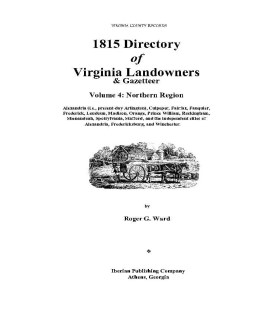 1815 DIRECTORY OF VIRGINIA LANDOWNERS & GAZETTEER, vol. 4 Northern Region
(Includes the counties and cities of Alexandria (i.e., present-day Arlington), Culpeper, Fairfax, Fauquier, Frederick, Loudoun, Madison, Orange, Prince William, Rockingham, Shenandoah, Spotsylvania, Stafford, and the independent cities of Alexandria, Fredericksburg, and Winchester ) abstracted by Roger G. Ward. 1997, vi, 220 pages, indices, maps.
1815 DIRECTORY OF VIRGINIA LANDOWNERS & GAZETTEER, vol. 4 Northern Region
(Includes the counties and cities of Alexandria (i.e., present-day Arlington), Culpeper, Fairfax, Fauquier, Frederick, Loudoun, Madison, Orange, Prince William, Rockingham, Shenandoah, Spotsylvania, Stafford, and the independent cities of Alexandria, Fredericksburg, and Winchester ) abstracted by Roger G. Ward. 1997, vi, 220 pages, indices, maps.

 THE REGISTER OF OVERWHARTON PARISH, STAFFORD COUNTY, VIRGINIA 1723-1758 AND SUNDRY HISTORICAL AND GENEALOGICAL NOTES
 OVERWHARTON PARISH, VIRGINIA REGISTER, 1720 TO 1760
 Virginia Merchants: Alexander Smith and Son; His Letter Book of 1803-1822


